The roundhouse at Bakersfield, ca. 1952.

Still active in June, 1974.

Prior to its removal in 1991.


'Purple Heart' Atmosphere Effective'
by Edwin Schallert
Prisoners of the Japanese, suffering brutal treatment at the behest of the nation's military machine, are doubtless as major an item of news as may be discerned today. For which reason "The Purple Heart", offered by Darryl F. Zanuck as the first production following his return to 20th Century-Fox, has a grim, topical and potent interest.
Directed by Lewis Milestone, the feature has many striking dramatic polnts to arrest attentlon, apart from its timeliness. It is an excellent picture in its early stages especlally, fades somewhat into tediousness after that. Its subject, while a particularly vital one, is rather forbidding for the audience pleasure-bent.
Speech Applauded
However, the public at Loew's State yesterday, where I witnessed the showing, applauded at the close of the film. The speech that tells the little yellow traitors off evoked a stirring response that spurred the climax. It gives a lift to the final portion of the picture. Thus it all more or less becomes a question of whether or not this is the type of entertainment desired today, and there seem to be negative as well as positive reponses.
Current program at Loew's, Chinese, Uptown and Carthay Circle theaters suffers in being too much given over to war issues anyway. March of Time reels dealing with postwar job arrangements keep in that groove. It is soundly illuminating, showing how the problems of canceled orders may be met by large manufacturing concerns. But this is documentary.
The only relieving event is, therefore, the Donald Duck cartoon. This discloses Donald disposing of an obnoxious trombone player, with the aid of Jupiter and Vulcan, who send him lightning bolts, and is delightfully and humorously imaginative.
Scenes in "The Purple Heart" which are quite intriguing display the pomp and ceremony of the court of judgment ruled by the Emperor of Japan and Society of the Black Dragon.
Those on trlal are an American bomber crew whose craft was downed in a storm and who were captured by deceit after the Tokyo raid. They are charged with the murder of civilians, destruction of schools and hospitals, all manner of trumped-up evidence being used against them.
Pawns in Rivalry
Suddenly they become the pawns in a conflict of jealousy between the army and the navy. Commander of the army asserts they have come from an aircraft carrier. The commander of the navy opposes this idea, as it is a reflection on his branch of the service.
There is more trickery and intrigue on the part of the military, third degrees and cruelties, all aimed at getting the men to confess how their flight started. They are depicted as a gallant crew ready to face torture and death rather than concede the information, finally openly and searingly defying their ruthless enemy.
Faults and Virtues
For all its pertinence to recent events in the Far East "The Purple Heart" lacks of that great reality which distinguishes finer achievements of this type. It reverts to sentimentalism at odd moments as, for example, the retrospect themed by the bathing of a man's wounds. A great deal of it relies too much on expressions on men's faces rather than strong action. Dullness creeps in on this account during the latter part of the feature.
Performances are worthy as given by Dana Andrews, Richard Conte, Farley Granger, Kevin O'Shea, Donald Barry, Sam Levene, Charles Russell,
John Craven, but outstanding are the oriental impersonations by Rlchard Loo, Peter Chong, H. T. Talang, Key Chang and various others. Talang all but deserves an Academy supporting award, and Benson Fong is good.


 |
| Fred Quimby and Tex Avery |
In the meantime, Tex Avery had scouted out a new form of lunchtime amusement for us. He found a comfortable nook behind one of the great facades that made up, as I recall, a Manhattan streetscape, and he put together a crap game, which soon became a respected lunchtime institution- albeit a short-lived one. Hearing about it, Quimby issued a proclamation forbidding gambling on the lot.

 |
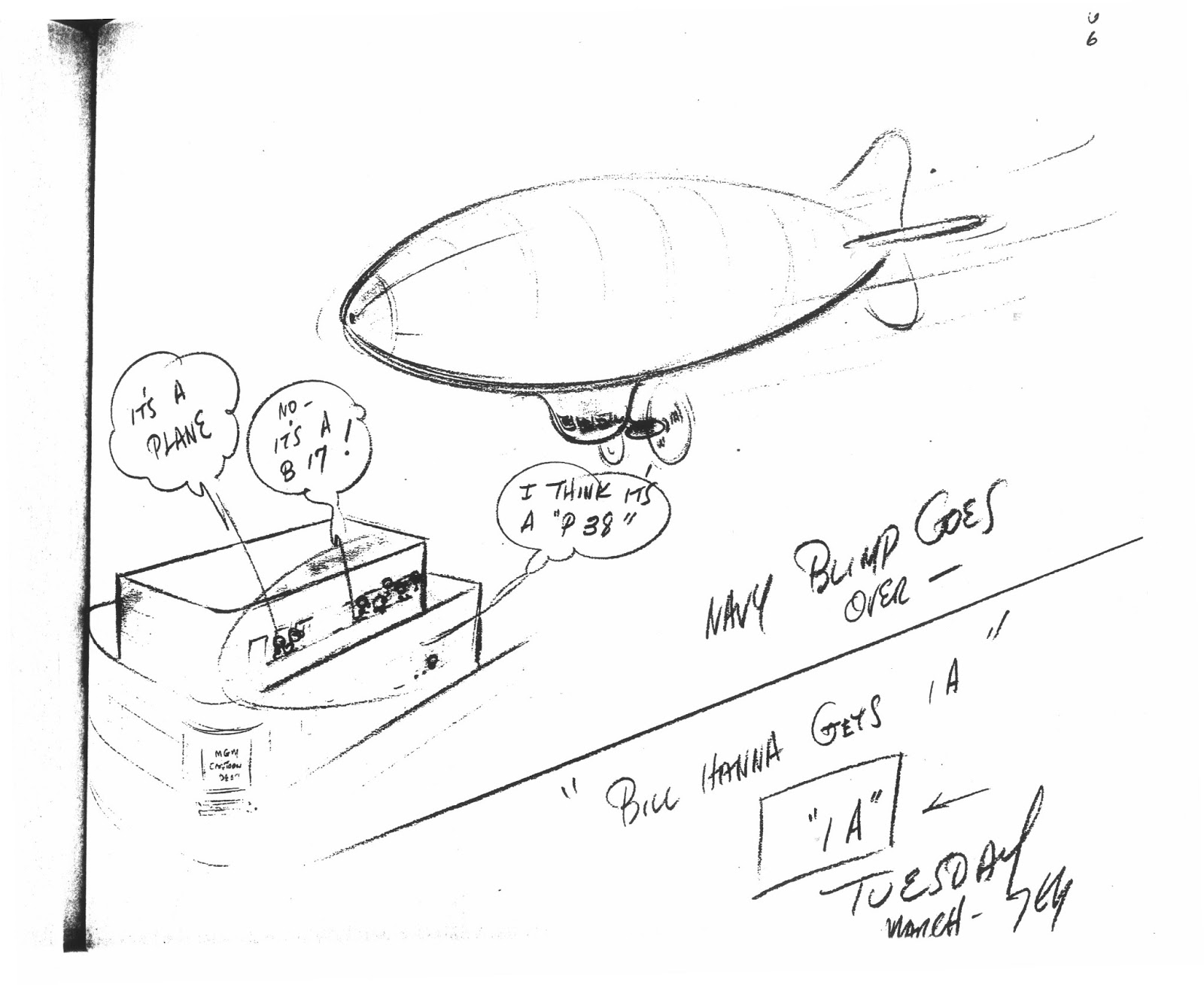
| Some of the Tom and Jerry crew pose with their seven Oscars in 1953. L to R: Ed Barge, Irv Spence, Dick Bickenbach, Joe Barbera, Bill Hanna, Ken Muse. Via Dave Wessels Comix. |


Franzen, with an evident and obvious pride, especially recalls something the artists called “the drop’. The animators worked on the second floor of a building they affectionately called “the warehouse”. Below them worked the cel painters. In stark contrast to the wacky world above them, absolutely no talking was allowed among the cel painters. They worked in cloisterous icy silence. To the animators this presented a challenge! For a while Franzen was not aware of the triggering mechanism, it seemed that at random intervals during any given week, suddenly a “drop” would occur. It started simply enough. Pencils. A coffee cup. Then more coffee mugs. Then larger objects… all simultaneously raining down on the floor in a violent cacophonous crescendo that always culminated in the dropping of a large metal sign and finally several brave souls lifting up and dropping an actual animation desk to the floor. This of course led to an explosion of boisterous laughter and applause… followed by silence and footsteps. The footsteps were those of the head cel painter as she headed upstairs to the second floor. She was a hard woman with no sense of humor, and every time she would appear on the second floor after a “drop”, she would be greeted with a combination of blank stares, muted smiles, and denial as she demanded, “What is going on up here?! It was months before Jim Franzen, the new guy on the second floor, found out that the trigger for these “drops” was simply the random sneezes of fellow animator Tony Rivera! How this tradition started remains a mystery even to this day…
We were required to do thirty feet of animation a week. Arnold Gillespie, who had worked at Disney, said he could do thirty feet a week but it wouldn't be his best work. He said he could do twelve feet and it'd be great. So they let him, and we worked together. We were the only guys working on that quota. Gillespie was also the first man to do pencil tests. We shot the scenes in pencil to see how it'd look.

 |
| Los Angeles Times, February 28, 1944 |